Warren Avenue Bridge
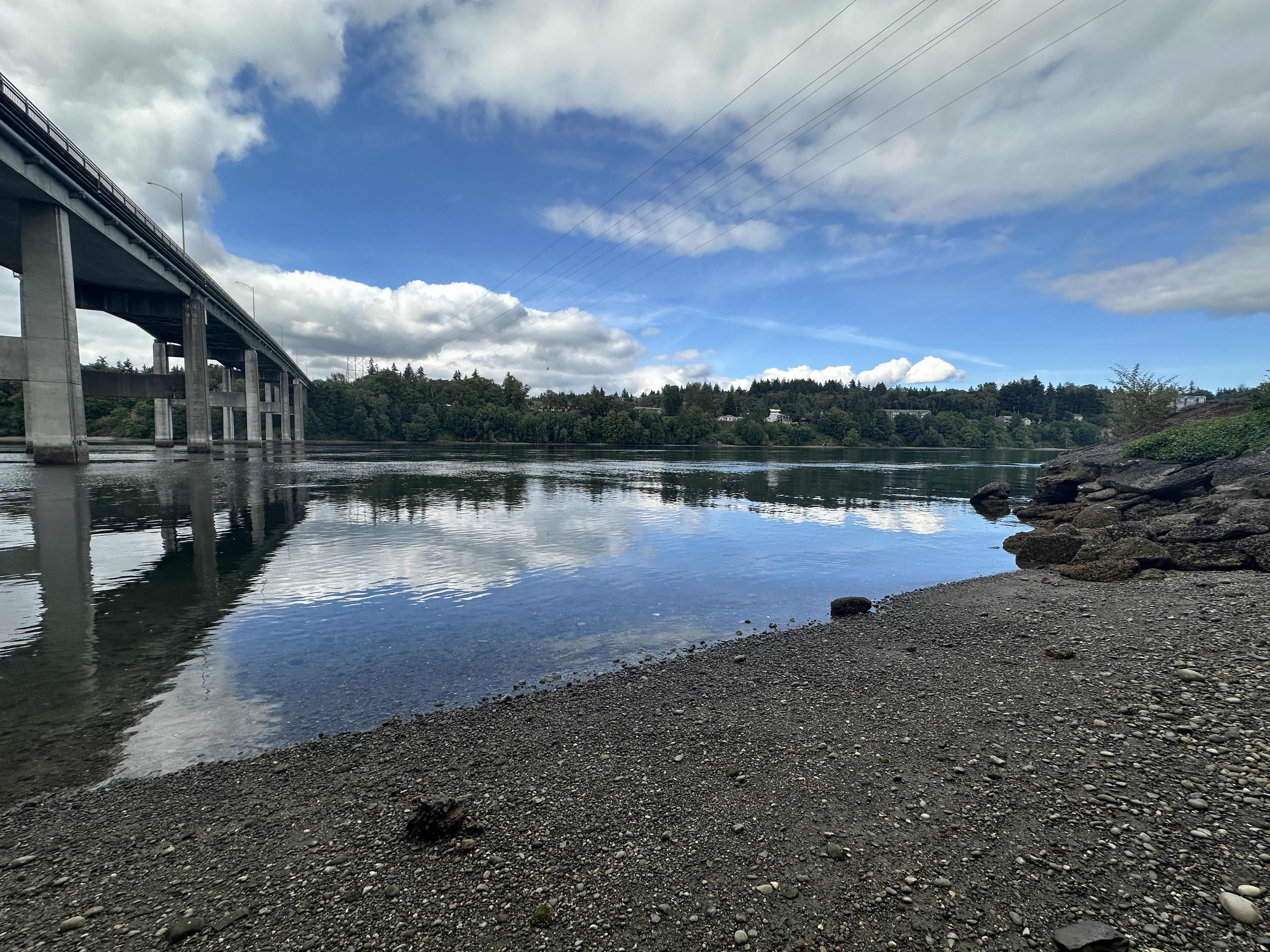
Warren Avenue Bridge is a shore dive in Bremerton, Washington, United States, from 1–16 m (3–52 ft). An advanced, current-critical shore dive — a few hundred yards of rough hand-carry buys you clay-bottomed pier circumnavigations at 20–40 fsw loaded with inverts, but only inside a tight ~40-minute slack window.
Site details
- Entry
- Beach/Shore
- Depth
- 1–16 m (3–52 ft)
- Environment
- Ocean/Sea
- Entry effort
- Hard (2 of 5)
- Surface swim
- 65 m (213 ft)
- Coordinates
- 47.57846, -122.63218
Site briefing
An advanced shore dive in every way, the Warren Ave bridge is a novel spot that doesn't take a haul to get to. Depths range from 20 fsw to 40 fsw depending on the tide and local bathymetry. The local attractions are the bridge piers, and the substrate is all clay with little muck/silt. Tons of life - mostly inverts, crustaceans, and the odd surf perch or two. Best to dive on the flood after the ebb - you'll have clearer water, and if you get off course, you'll drift towards Sinclair inlet instead of the Manette bridge. This dive should be considered only if you can manage currents, have solid navigation skills, have the strength to go down and up the beach access, and can get your gear to the water with a few hundred yards of hand carry over a rough path with tens of feet of elevation change.
A few need-to-know things: - Currents and their impacts here are significant; at some parts of the year, they exceed 5 knots. Due to the narrow dive window around slack, it's only feasible to do a 1-tank dive for about 40 minutes (tops). When planning, aim for no more than 0.3kt either side of the window. - Boat traffic is a consideration; bring a dive flag and your DSMB. - You'll need bins/bags to get your gear down to the staging area - a cart won't do it. - The currents are worth mentioning again - changes between ebb and flood are rapid. - Some bottom hazards: general junk, some cables, and the odd golf ball.
Access is via the public path at the end of Elizabeth Ave, and parking is at the road end. Organize your gear and plan on 2 or 3 trips back and forth to get it all down to the greenspace for staging. Be very careful when accessing the rocky beach - there's broken concrete, large cables to trip over, pebbles that make it moderately hazardous to walk in rock boots, and no handrail. A good plan is to assemble all your gear in the greenspace and work with your dive buddy to pass it down to the beach.
Entry and route
Shore dive - Place your dive flag between piers 1 and 2, with enough scope and weight to keep it from getting dragged around. Continue swimming out to Pier 2 and circumnavigate the footing on both the A and B sides. Pay attention to the water movement; depending on the current's strength, there may be eddies. If you have time remaining in your window, you can head to Pier 1. Between the two, there's a large pipe, a few cracks, and you can complete your safety stop and head to shore. Collect your flag from the surface, since it'll be very difficult to find the line in the current, in the shadow, and with reduced viz.
Tides and currents
- Nearest NOAA tide station: Bremerton, Sinclair Inlet, Port Orchard (9445958)
- Nearest NOAA current station: Port Washington Narrows, Warren Ave. Bridge (PUG1510)
MyDivingSites forecasts tide, current, swell, and weather for Warren Avenue Bridge hour by hour.
Dive reports from Warren Avenue Bridge
3 logged dives, average rating 4.0 out of 5, average visibility 2.3 m (8 ft).
- Sep 19, 2026 · Joe · visibility 2 m (7 ft) — Hosted the Sound Dive Center Community Dive in September 2026. It was really good! The slack window was long today for this site, and the current was very light (the app showed the timing and data for current, tide, and depth were correct). 8 divers, incl. me, in at 13:00 and out by 14:00; very little current effect after 13:15. Tons of life. And golf balls. Crab party on the former tube worms. Seen: Kelp Greenling, Ochre Star, Leather Star, Red Rock Crab, Kelp Crab, Plumose Anemone (White Variety), Blood Star, California Sea Cucumber, Orange Burrowing Sea Cucumber, Large Anemones, Piddock Clam, coralline algae, tube worm.
- Jul 7, 2026 · Joe · visibility 2 m (7 ft) — Glad I did it, and it was a lot of work. We placed the dive flag first between piers 1 and 2 and tried to navigate to pier 2 underwater. Didn't find it, surfaced to get reoriented, noticed the flag was dragging, and repeated the process - this time set the flag weight in front of pier 1 with enough scope for it to drift out. Descended on pier 1 as a reference, navigated to pier 2, went around the whole footing, and came back a bit to the west, due to current drift. All in all things were on plan - in and out before the current kicked up too high and went out to pier 2 and back with reasonable accuracy. Debriefed on the effects of the current, potential issues with site access, and then celebrated arm day, getting all the gear back up from the dive site. Seen: Mottled Star, Red Rock Crab, Kelp Crab, Plumose Anemone, Egg-Yolk Jellyfish, Short Spined Star, California Sea Cucumber, Orange Burrowing Sea Cucumber, Large Anemones, Piddock Clam, surf perch, bryozoan.
- Jul 6, 2026 · JUSTIN · visibility 3 m (10 ft) — Very cool dive site, but very current dependent. Entry is challenging so go with multiple teams so you can help lug gear from vehicle down stairs.
Marine life seen here
- California Sea Cucumber (Parastichopus californicus) — seen on 2 dives
- Kelp Crab (Pugettia producta) — seen on 2 dives
- Large Anemones (Various species (e.g., Anthopleura xanthogrammica, Metridium senile)) — seen on 2 dives
- Orange Burrowing Sea Cucumber (Molpadia arenicola) — seen on 2 dives
- Piddock Clam (Various species (e.g., Zirfaea pilsbryi, Penitella penita)) — seen on 2 dives
- Red Rock Crab (Cancer productus) — seen on 2 dives
- Blood Star (Henricia leviuscula) — seen on 1 dive
- Egg-Yolk Jellyfish (Phacellophora camtschatica) — seen on 1 dive
- Kelp Greenling (Hexagrammos decagrammus) — seen on 1 dive
- Leather Star (Dermasterias imbricata) — seen on 1 dive
- Mottled Star (Evasterias troschelii) — seen on 1 dive
- Ochre Star (Pisaster ochraceus) — seen on 1 dive
- Plumose Anemone (Metridium dianthus) — seen on 1 dive
- Plumose Anemone (White Variety) (Metridium dianthus) — seen on 1 dive
- Short Spined Star (Pycnopodia helianthoides (Juvenile or smaller morph)) — seen on 1 dive
Nearby dive sites
- Illahee State Park — 2.3 mi (3.6 km) away
- Fort Ward — 4.7 mi (7.6 km) away
- Rockaway — 6.5 mi (10.5 km) away
- Metridium — 6.5 mi (10.5 km) away
- Harper Pier — 6.6 mi (10.6 km) away